PCB Designer & Graduate Research assistant · CU Boulder
Designing boards from napkin sketch to working silicon: power delivery networks, signal integrity, and embedded systems — documented across 4 boards and 8 labs.
I am a Graduate research assistant in Computer Science at CU Boulder with a background in Electrical Engineering. My research focuses on microfluidic lab-on-a-chip systems, digital microfluidics, embedded electronics, and hardware-software integration for biomedical applications. I am interested in developing practical intelligent systems that combine hardware, software, and AI to solve real-world problems in biomedical engineering, and robotics.
This portfolio documents my journey through Practical PCB Design & Manufacture (ECEN 5730) — from first principles (Thevenin equivalents, loop inductance, decoupling capacitor selection) through full-stack board design in Altium Designer, assembly, oscilloscope bring-up, and formal reporting.
Every board I designed passed bring-up with zero hard errors. My Golden Arduino (Board 3) achieved 6× lower near-field emissions than a commercial Arduino Uno.
Four full PCB designs and eight hands-on labs — each building systematically on the last, from breadboard prototyping to multi-layer professional boards.
This lab compares the NE555 bipolar timer and the TLC555 CMOS timer in astable mode. I built the circuit on a solderless breadboard, measured frequency, rise time, fall time, and LED load current, and then selected the better timer for the PCB design.
A 555 timer can generate a repeating square wave without an external trigger. The frequency and duty cycle are controlled by two resistors, RA and RB, and one timing capacitor. This makes the 555 timer useful for blinking LEDs, clock pulses, tone generation, and PWM-style timing.
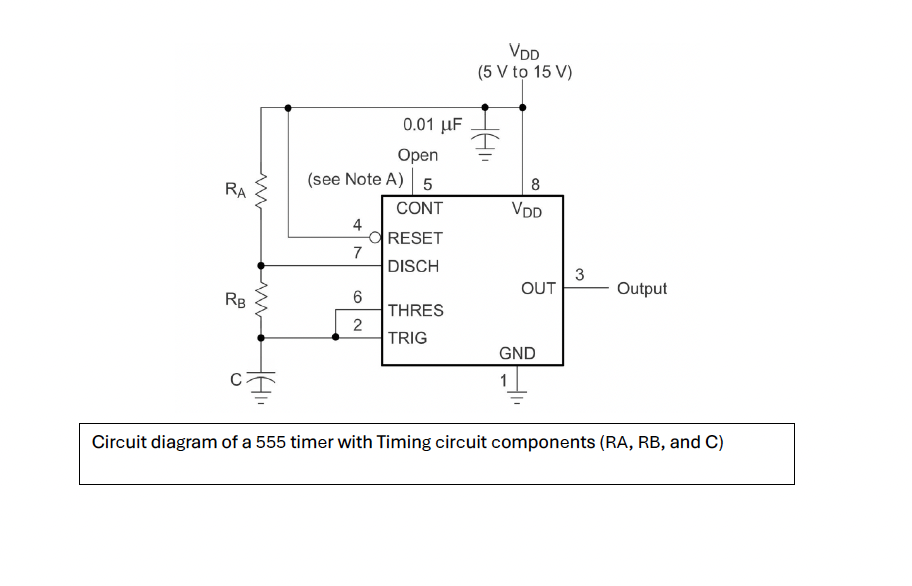
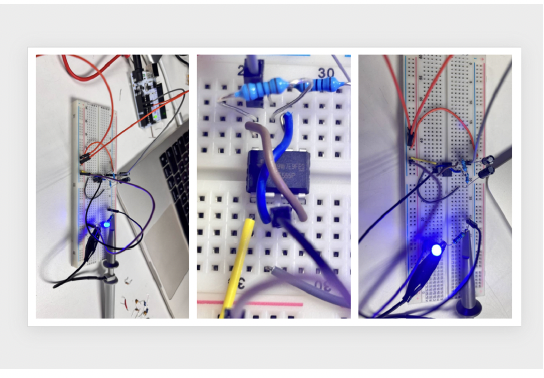
I placed the 555 timer circuit on a solderless breadboard and powered it with 5 VDC. The output was connected to the oscilloscope so I could measure frequency, duty cycle, rise time, fall time, and LED load current using different resistors.
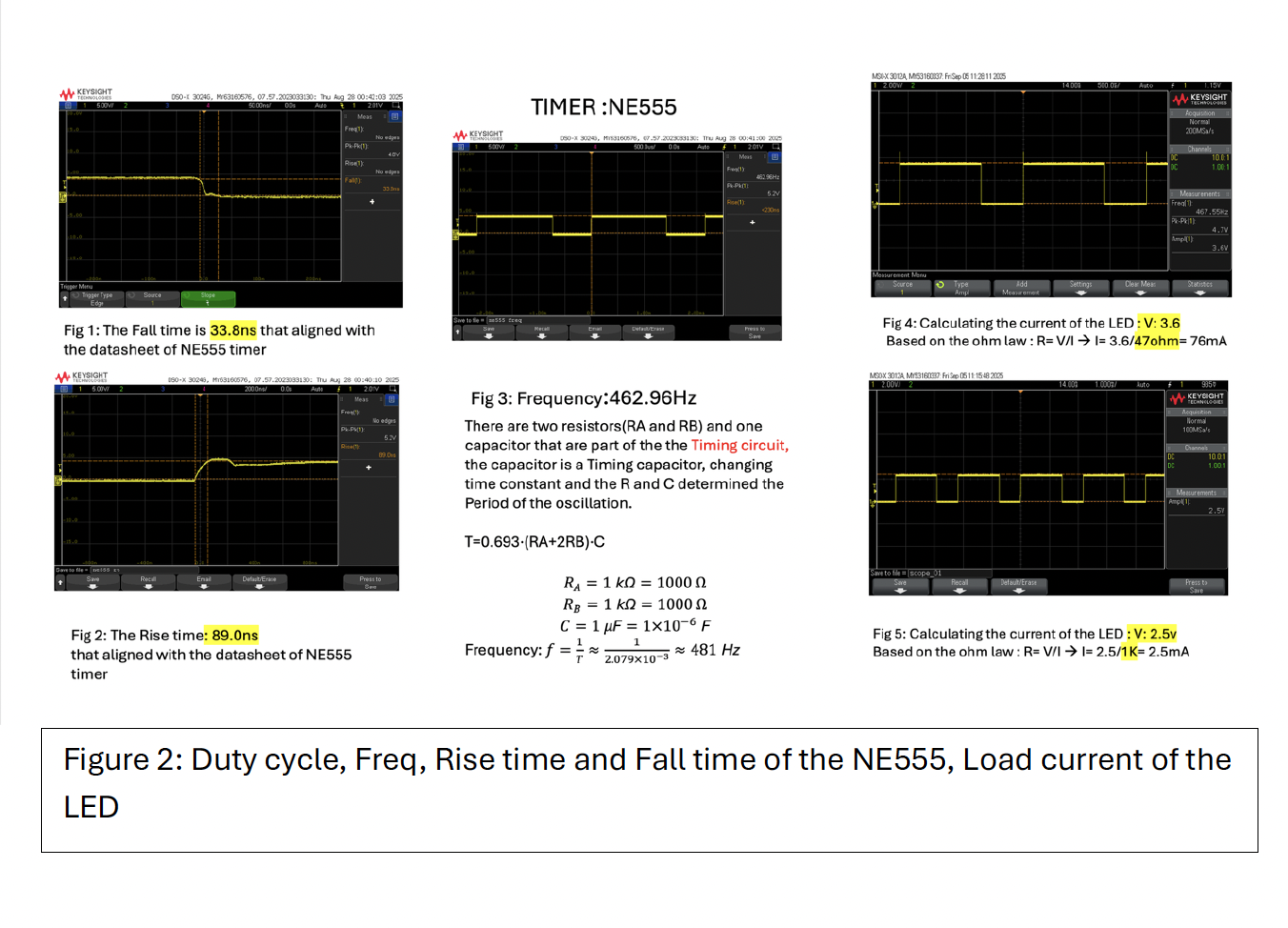
For the NE555 timer, the measured frequency was about 463 Hz, close to the theoretical value of about 481 Hz for RA = 1 kΩ, RB = 1 kΩ, and C = 1 µF. The measured rise time was 89 ns, and the fall time was 33.8 ns. The NE555 also provided higher output current when driving the LED load.
I repeated the same test with the TLC555 CMOS timer. The measured frequency was close to the NE555 result, but the TLC555 switched much faster. The measured rise time was about 14.8 ns, and the fall time was about 11.1 ns.
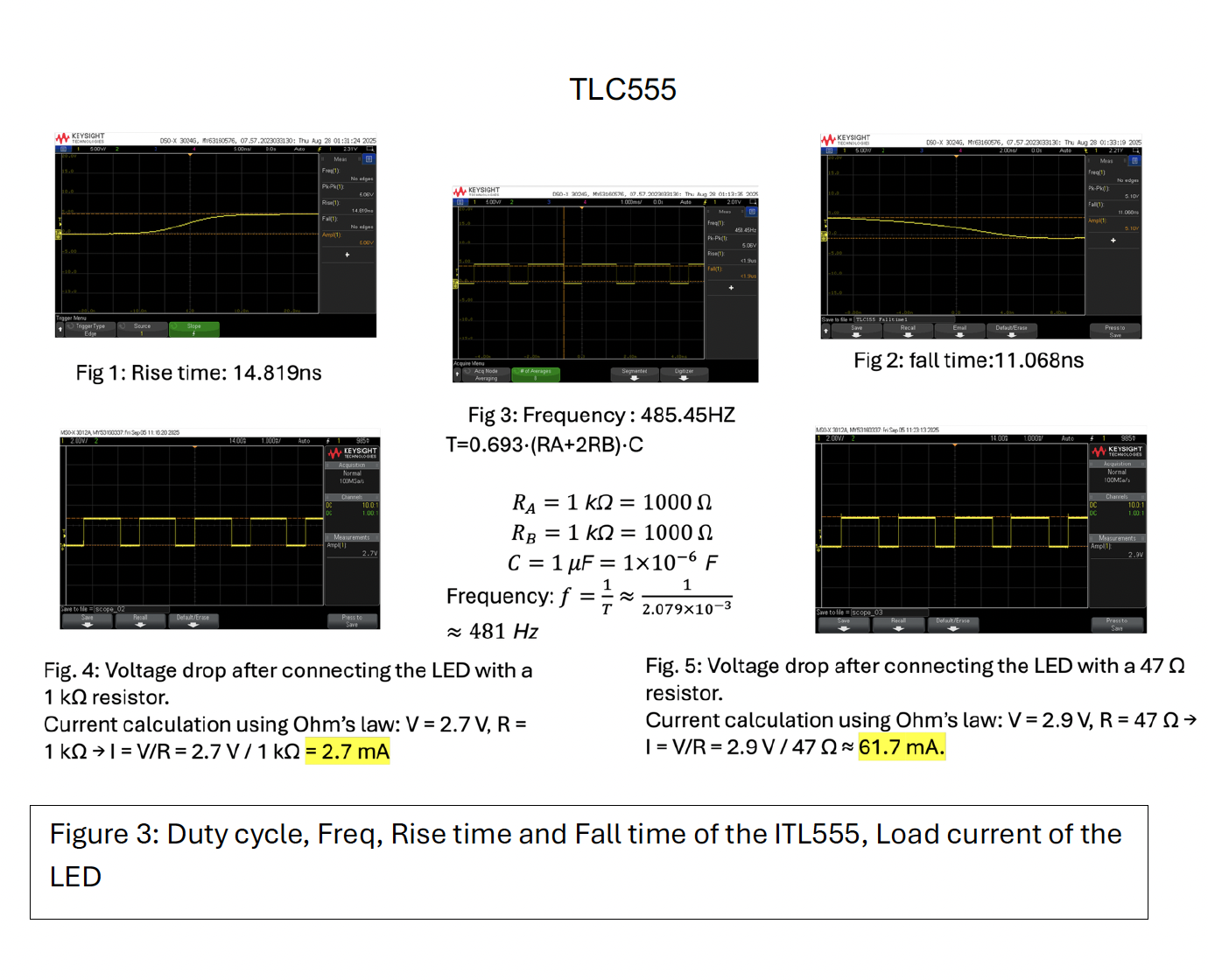
Both timers produced nearly the same oscillation frequency, but their output behavior was different. The TLC555 had faster switching edges, while the NE555 provided stronger current drive for the LED load.
| Measurement | NE555 | TLC555 |
|---|---|---|
| Rise time | 89 ns | 14.8 ns |
| Fall time | 33.8 ns | 11.1 ns |
| Frequency | ≈463 Hz | ≈485 Hz |
| LED current with 1 kΩ | 2.5 mA | 2.7 mA |
| LED current with 47 Ω | 76 mA | 61.7 mA |
This lab studies how sudden current switching affects a 9 V power rail using a slammer circuit. I built the circuit on a solderless breadboard, measured voltage droop during slow and fast switching edges, and compared how 1 µF and 1000 µF decoupling capacitors reduce power rail noise when placed near or far from the switching transistor.
This lab compares switching noise, edge speed, and rail stability for three layout cases: good layout, good layout with the decoupling capacitor far away, and bad layout. The goal is to show how return path quality and capacitor placement affect high-speed digital behavior.
| Layout | Rise Time | Fall Time | Rail Collapse |
|---|---|---|---|
| Good Layout | 2.25 ns | 1.89 ns | 274 mV / 181 mV |
| Bad Layout | 4.86 ns | 3.92 ns | 1031 mV / 2763 mV |
| Good, Cap Far | 3.78 ns | 2.47 ns | 709 mV / 829 mV |
This report demonstrates how PCB layout decisions affect switching noise and power delivery network behavior. The board compares two identical hex inverter circuits: one with good layout practices and one with poor layout practices. The good layout uses close decoupling and a continuous return plane, while the bad layout uses longer return paths and far decoupling.
| Measurement | Good Layout | Bad Layout |
|---|---|---|
| Rise time | 1.76 ns | 5.58 ns |
| Fall time | 2.64 ns | 9.86 ns |
| Quiet High Vp-p | 690 mV | 1900 mV |
| Rail compression | 0.917 V | 1.85 V |
| Output Thevenin resistance | ≈66 Ω | — |
This lab studies how ground noise affects analog measurements. I used a TMP36 temperature sensor, ADS1115 16-bit ADC, Arduino Uno, and I²C communication to compare single-ended and differential measurements under normal and noisy ground conditions.
This lab measures steady-state and inrush current in a 555 timer circuit. I used a 1 Ω sense resistor and oscilloscope math mode to measure the voltage across the resistor and convert it to current.
This board is a custom Arduino Uno-style design built with ATMEGA328, CH340G USB-to-UART, a 3.3 V LDO, USB mini-B, ICSP bootloading, ferrite filtering, crystals, status LEDs, and test points for validating power, USB, I²C, UART, and SPI signals.
This lab builds a breadboard version of the VRM Characterizer. The circuit applies a controlled load current, measures open-circuit and loaded voltage, and computes the Thevenin resistance of voltage sources using Arduino, DAC, ADC, op-amp, MOSFET, and a sense resistor.
Instrument Droid is a custom PCB designed to automatically measure the Thevenin resistance of a voltage supply up to 12 V. The board integrates ATMEGA328 control, DAC/ADC measurement, op-amp buffering, MOSFET loading, OLED display, smart LEDs, buzzer, USB interface, and test points for validation.
Measured on a 1–5 scale at the start and end of ECEN 5730. Evidence links to project deliverables.
| Skill | Before | After | Evidence |
|---|---|---|---|
| KiCad PCB Design | 2/5 | 4/5 | Schematic → Layout workflow |
| Altium Designer | 1/5 | 4/5 | Board 2–4 full designs |
| DFM / DRC / Gerbers | 1/5 | 5/5 | All boards ordered from JLC |
| Signal Integrity | 1/5 | 4/5 | Good/bad layout Lab 15 |
| Power Integrity | 1/5 | 4/5 | Lab 5 decoupling study |
| Oscilloscope / Probing | 2/5 | 5/5 | Inrush, NFE, quiet-node |
| Embedded / Arduino C | 2/5 | 4/5 | Board 4 firmware, I²C driver |
| Thevenin / PDN Analysis | 1/5 | 5/5 | Lab 5, Board 3 & 4 |